Subversive Stitching - the story of A.T. Casdagli
Recently, I came across a picture of a piece of embroidery made by a British major, A.T. Casdagli, while he was imprisoned in a concentration camp during World War II.
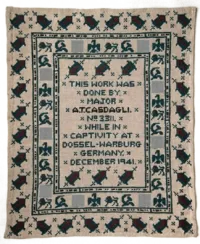
I was curious about it and as I was looking for more information on it, things got out of hand and I ended up downloading and reading the whole book with the diary he kept during the four years he was imprisoned.
He joined the army when the war started in 1939, saying goodbye to his wife, Joyce, and his son, Tony, and going to Egypt. It was also around this time that he began embroidering, and this cross-stitch was his first piece: 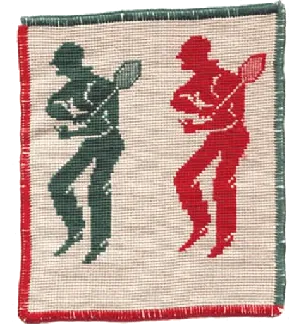 he also played squash
Eventually, he was transferred to Greece and it was there, in 1941, that he was captured by the germans.
After six months in a concentration camp (or rather, his first concentration camp), he lucked onto canvas and needles and started using threads and yarn from his companions' clothes to embroider. There were many embroidered pieces, some quite daring, all quite subversive, and I compiled some of them with the information I found in the book - which, by the way, can be downloaded here.
This is going to be a bit long, and not all of the images are in great quality, but I did my best.
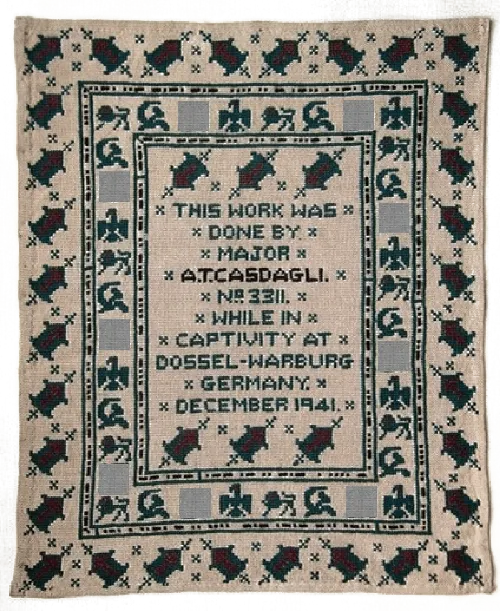 secret message
This was the one that led me to this journey. As far as I'm aware, this was the first one he did after he was mprisoned.
I blurred out the symbol representing Germany - but you know what it is. The lion represents England, the hammer and sickle represent the USSR, and the eagle represents Italy.
The beauty of this embroidery is that the seemingly random lines on the edges are actually the words “God Save the King” and "Fuck Hitler" repeated several times in Morse code, and not only that, it was displayed in several nazi prisons without the germans ever knowing about the hidden messages. The audacity!
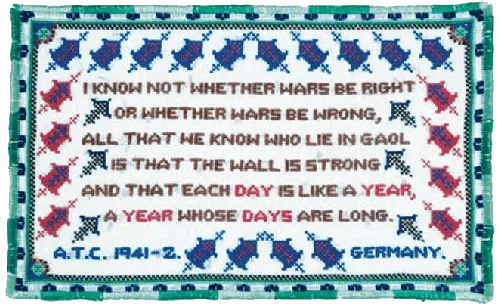 based on the Oscar Wilde's poem "The Ballad of Reading Gaol"
(he switched the word “laws” to“wars”)
"I know not whether Laws be right,
Or whether Laws be wrong;
All that we know who lie in gaol
Is that the wall is strong;
And that each day is like a year,
A year whose days are long.
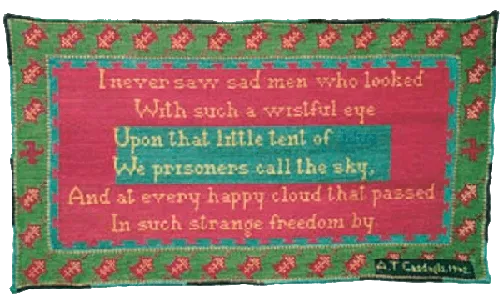
From the same poem:
"I never saw a man who looked
With such a wistful eye
Upon that little tent of blue
Which prisoners call the sky,
And at every drifting cloud that went
With sails of silver by."
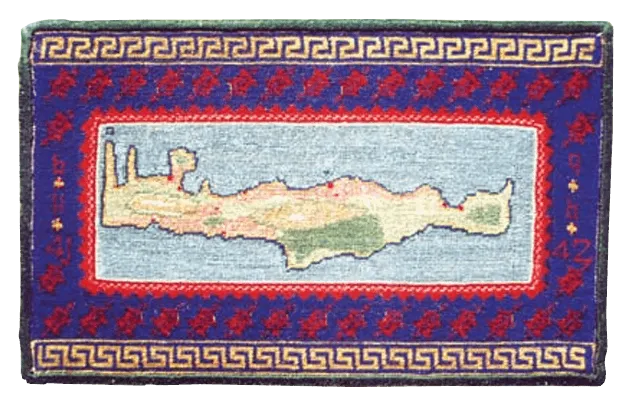 Map of Crete, where he was captured
According to his diary, this piece has about 45,000 stitches (!!!), took more than 190 hours (!!!) to be completed and it was made with threads from General Kaffato's pajamas. General Kaffato was a greek general who was also captured in Crete. As Casdagli spoke greek very well (not only he had lived in Greece, he was also of greek descent), he even taught english to the greeks and greek to the english while he was imprisoned.
The two also worked together as translators and for that they got to share a room for a while, just the two of them. They spent a total of 14 months together and developed a very strong friendship. Even after they were apart (the general was transferred at some point), he was still mentioned frequently in the diary. It's quite beautiful.
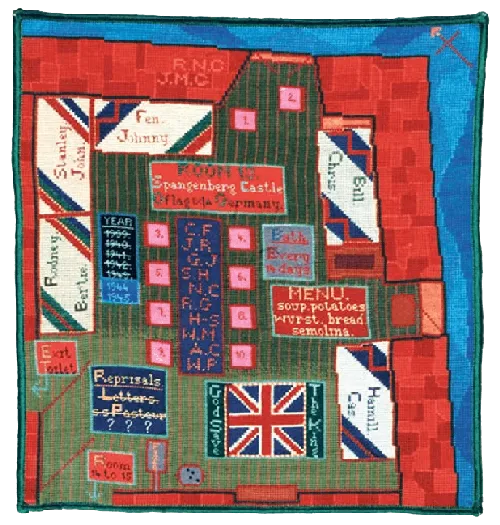 room 13
This is a map of the room he shared with other POW - based on a drawing made by one of them - marking their bunks and places at the table. As it was forbidden to display national flags, when the embroidery was hung on the wall, the flag of England was covered by a piece of cardboard with a “do not pull” sign written in German.
When the Germans entered the room, pulled out the cardboard and said it was forbidden, the Major used to reply “you're the one showing it, not me" - proving that humor can also be subversive. Or as he put it at another passage in his diary, “it (a sense of humor) certainly helps one and simply infuriates the Germans".
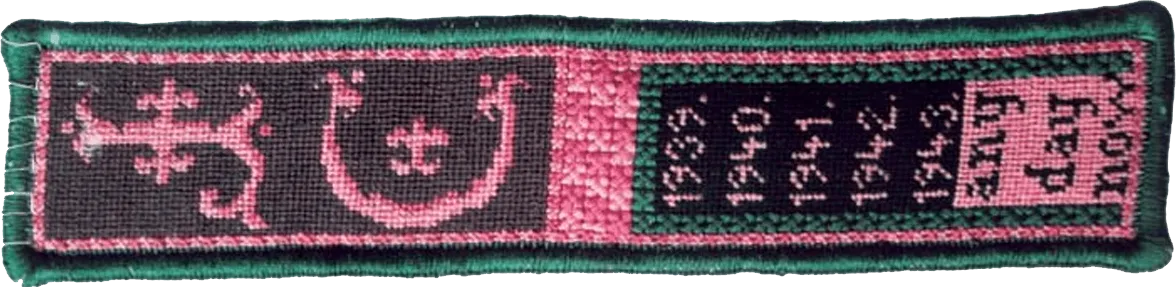 any day now
This one he made for his wife Joyce, with her initials and the years that they had been apart.
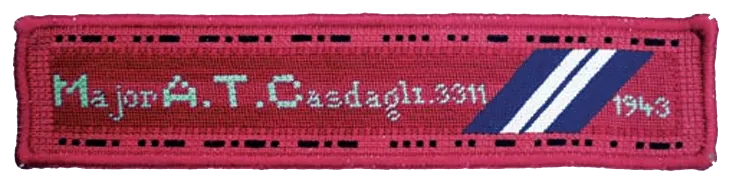 a bookmark
Another daring one, with his name, POW number, the colors of the school he attended, and Fuck Hitler in Morse code again.
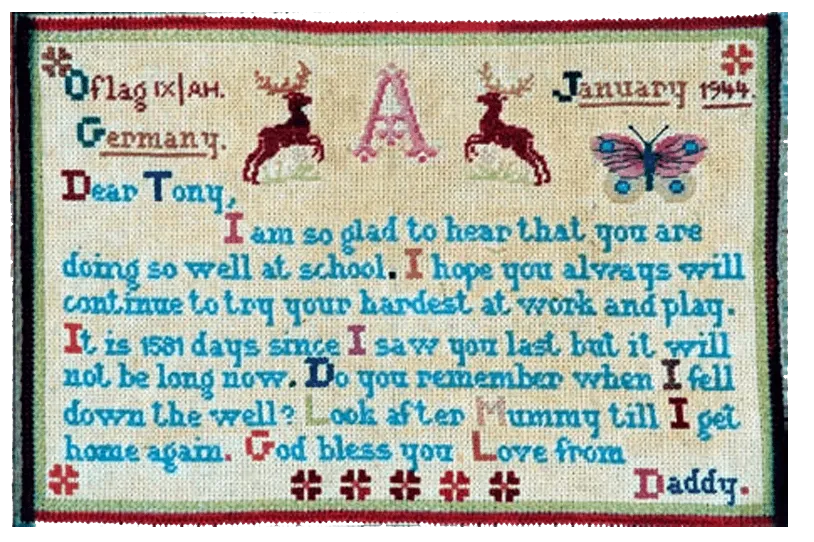 letter to Tony
This beautiful letter is to his son Tony. Can you imagine, stitching a letter? Not only the letter, but the concept of stitching a letter really got to me.
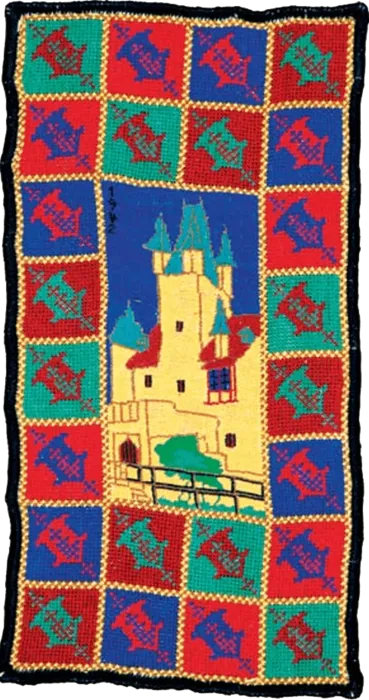 castle Spangenberg
A castle in Germany that was the concentration camp where he spent most of his time.
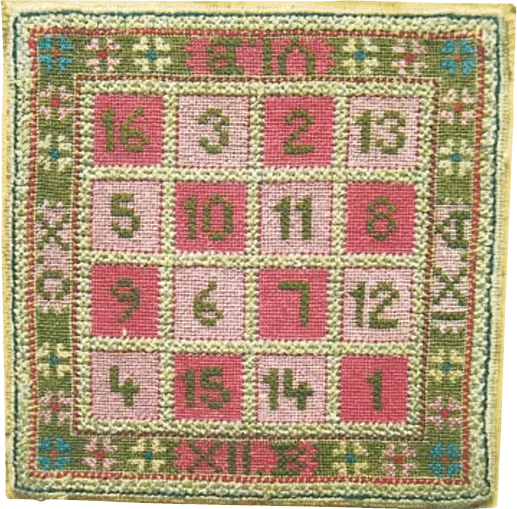 magic square
On each side of this one there's the number of a concentration camp he was in. As I understand it, this was the last one he did while he was still imprisoned, months before the end of the war.
In April 1945 is when he was finally a free man again. When he returned home, he found himself in a situation quite different than what he expected, so he and his wife got divorced and he requested to be transferred back to Greece. There, he managed to meet General Kaffato twice, met his second wife, and had a daughter, Alexis - who wrote the introduction and epilogue to the book.
In the 1950s, it's said that he returned to stitching daily for at least three hours, until he was 87.
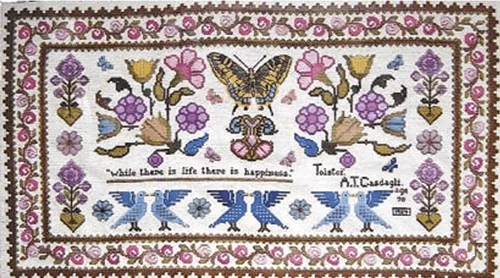 while there is life there is happiness
In 1984, he made this piece with a quote from Tolstoi's War and Peace, which he read while he was still imprisoned. He submited the piece to a contest and came in second place for the Needlewoman of The Year. He died at the age of 90, in 1996.
In this 2011 interview his son Tony (who, by the way, also became a stitcher himself), says his father used to say that "Red Cross saved his life but his embroidery saved his sanity."
In several passages of his diary, the Major mentions other things that helped him pass the time, such as musical performances (I find it funny that he describes one of them as "quite amusing but not much talent"), theater performances, as well as writing, drawing, etc.
Let this be a lesson to those who dare to say that art is not important.
PS: English is not my first language, so please forgive me if there's some misused of words or something and, of course, feel free to send me a message so that I can fix it.
here's a great video which mentions this and many other subersive stories. one of them includes pasta.
if seeing toys beating up a Nazi soldier is something that appeals to you, I'll leave the link for an excellent Czech animation here
portuguese versionhere)